
 IT ONLY TAKES A MINUTE!

Top 10 Best Franking Machines UK: 2026 Prices & Reviews

Most businesses don't go looking for a franking machine because they love post. They go looking because someone in accounts noticed how much is being spent on stamps, or because the office manager is fed up queuing at the Post Office with a carrier bag of envelopes. Either way, the question is the same: which machine is actually worth paying for?
We've pulled together the ten machines we'd shortlist for a UK business in 2026, from tiny desktop units for a couple of dozen letters a day up to automatic mailroom kit that'll chew through thousands. Every machine on this list is Mailmark capable, because since 1 January 2023 Royal Mail only accepts franked mail carrying a Mailmark barcode. Anything older is a doorstop.
Quick picks
If you just want the short version, here it is:
- Best for very low volume: Quadient iX-1, 18 letters a minute, made for small offices.
- Best all rounder for a small office: FP PostBase Vision 3S or Quadient iX-3.
- Best for a busy front desk: Pitney Bowes SendPro C, 50 letters a minute with a 5kg scale.
- Best for mixed mail and parcels: FP PostBase Vision 7A, with differential weighing.
- Best for a proper mailroom: Quadient iX-7, up to 175 letters a minute.
Keep reading for why, and where each one falls down.
How we ranked them
We didn't give marks for glossy brochures. We looked at five things that actually change what you'll pay and how much time you'll save:
- Daily volume fit. A machine that's too big costs more each month for no reason. Too small and someone spends their afternoon feeding envelopes one at a time.
- Speed in letters per minute. Manufacturers quote best case figures, so treat them as a ceiling, not a promise.
- Scale size. If you send parcels, a 2kg scale is a pain. You'll end up weighing items on a separate platform.
- Automation. Auto feeders, sealing and differential weighing (where the machine works out each item's weight as you lift it off a stack) are what separate mailroom machines from desktop ones.
- Contract terms. Price per month matters, but so does the length of the lease, the auto renewal clause and what the exit fee looks like.
Specs below come from manufacturer and dealer spec sheets, checked October 2026. Postage figures are Royal Mail's own published prices from 7 April 2026, checked October 2026.
The 10 best franking machines in 2026
1. Quadient iX-1
The iX-1 is Quadient's entry machine and it's built for the office that sends a handful of letters each day. It runs at around 18 letters per minute, which sounds slow until you realise most small firms post fewer than 30 items a day. At that level you'll never notice the speed.
Good for: sole traders, small practices, lettings offices. Watch out for: extra accounts and label options are paid add ons on some contracts, so check what's included before you sign.
Quadient is the company that used to be called Neopost. It changed its name on 23 September 2019 and finished the switch in 2020, so if you see an older machine with Neopost branding, that's the same business. Read our Neopost range page for the older models.
2. FP PostBase Vision 3S
FP's smallest Vision model handles roughly 30 letters a minute and comes with a 2kg integrated scale and a 5mm thickness limit. Dealers suggest it for up to about 200 items a day. It's a tidy desk machine with a touchscreen, and FP's online account tools are easy to get on with.
Good for: offices that send mainly letters with the odd small packet. Watch out for: the 2kg scale and 5mm thickness. Thicker large letters will need a label.
3. Quadient iX-3
Step up from the iX-1 and you get roughly 45 letters a minute and envelopes up to C4 size (229 x 324mm). Weighing platforms from 3kg up to 35kg are available as options, so it copes with parcels better than most desktop machines. It also runs Quadient's S.M.A.R.T. software for tracking spend by department.
Good for: small and mid sized offices with a few departments that want to split postage costs. Watch out for: the bigger weighing platforms push the monthly price up. Only pay for one if you post parcels regularly.
4. Pitney Bowes DM50
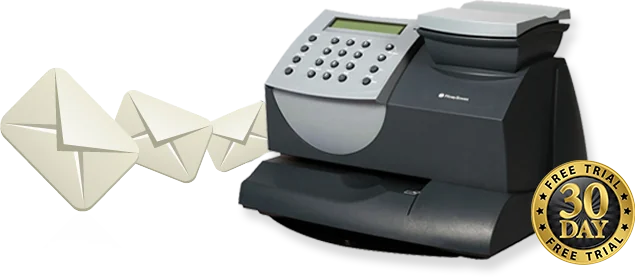
Pitney Bowes has sold the DM range in the UK for years and plenty of small businesses still use them. They're simple, reliable and compact, and you can see our full DM50 review for the detail. If you're replacing an older non Mailmark machine, ask your supplier whether your exact model is Mailmark enabled, because only those can still frank mail.
Good for: businesses that want a no fuss machine from the biggest name in the market. Watch out for: Pitney Bowes contracts are known for long terms. Read the renewal clause.
5. Pitney Bowes SendPro C
The SendPro C is where Pitney Bowes gets interesting. It's semi automatic, runs up to 50 letters a minute, handles envelopes up to 9.5mm thick and comes with a 5kg scale as standard, with 7kg, 12kg and 35kg options. It connects over Wi-Fi or LAN and gives you up to 100 department accounts.
Good for: busy reception desks and small mailrooms where one person does the post at the end of the day. Watch out for: you're paying for connectivity and software, so make sure someone will actually use the reporting.
6. FP PostBase Vision 5S
The 5S is the middle child of the Vision range: about 50 letters a minute, a 5kg scale, 8mm thickness and automatic label dispensing. Dealers pitch it at up to around 300 items a day. If you send a steady mix of letters and small parcels, this is a sweet spot.
Good for: growing ecommerce sellers who still post a lot of letters too. Watch out for: no differential weighing, so mixed mail still needs sorting by hand.
7. FP PostBase Vision 7A
Now we're into automation. The 7A runs at around 75 letters a minute, has a 7kg scale, takes items up to 10mm thick and adds differential weighing. That last bit is the big win: you put a stack of mixed weight mail on the scale, and the machine charges the right postage for each item as you take it off. No pre sorting.
Good for: offices posting 300 to 500 mixed items a day. Watch out for: a conveyor stacker is optional, not standard.
8. Quadient iX-5
The iX-5 runs at 75 letters a minute hand fed, or about 110 with the automatic feeder. There's a colour touchscreen, an optional label printer and a differential scale. It's a proper workhorse for a mid sized business.
Good for: companies with a dedicated post room but not a huge one. Watch out for: the auto feed version costs a lot more than the hand fed one. Be honest about whether you'll batch enough mail to need it.
9. FP PostBase Vision 9A
The top of FP's Vision range: up to 120 letters a minute, a 10kg scale, 16mm thickness and dynamic weighing (it weighs items on the move). A power conveyor stacker is included. Dealers suggest it for over 800 items a day.
Good for: big offices, councils, schools and colleges with a central mailroom. Watch out for: it's big. Measure the space first.
10. Quadient iX-7
The iX-7 is the fastest machine on this list at up to 175 letters a minute through its mixed mail feeder, with dynamic weighing at about 110 items a minute. It takes envelopes up to 254 x 330mm and works with weighing platforms up to 35kg. You can add a power conveyor stacker and a second label printer.
Good for: high volume senders who need speed and accounting by cost centre. Watch out for: quotes vary hugely depending on the options you add. Get at least three.
Price table
We don't print list prices for leases because they move with every promotion and depend on term, volume and options. What we can show you is exactly how much each item costs to post once it's franked, against stamps. These are Royal Mail's prices from 7 April 2026 (checked October 2026).
| Item | Stamp price | Mailmark franked price | Saving per item |
|---|---|---|---|
| 1st Class letter (100g) | £1.80 | £1.77 | 3p |
| 2nd Class letter (100g) | 91p | 88p | 3p |
| 1st Class large letter (100g) | £3.30 | £2.86 | 44p |
| 1st Class large letter (101g to 250g) | £3.60 | £3.28 | 32p |
| 2nd Class large letter (100g) | £1.55 | £1.52 | 3p |
| 2nd Class large letter (501g to 750g) | £2.70 | £2.50 | 20p |
Sources: Royal Mail UK stamp prices and Royal Mail Business Price Guide, both valid from 7 April 2026, checked October 2026.
Look at that table carefully, because it tells you something most brochures won't. On standard letters the saving is just 3p an item. The real money is in 1st Class large letters, where franking saves 32p to 44p each time. If your post is mostly A4 envelopes going 1st Class, a franking machine pays its way fast. If it's mostly 2nd Class standard letters, you'll need real volume before the lease is covered.
Here's a quick worked example. Say you send 40 1st Class large letters (under 100g) a day, five days a week, for about 50 weeks a year. That's 10,000 items. At 44p saved per item, you save £4,400 a year on postage alone. Compare that to 40 2nd Class standard letters a day: same 10,000 items, but at 3p each it's only £300 a year, which probably won't cover the machine.
Not sure where you sit? Our franking savings calculator does the maths for you.
Rent, lease or buy?
You've got three ways to get hold of a franking machine, and each suits a different business.
Rent. Short contracts, usually including servicing, and you can hand it back at the end. Good if your post volume might change or you're not sure franking will stick. Have a look at our franking machine rental guide.
Lease. The most common route. You pay monthly over a fixed term, typically several years. The monthly cost is lower than renting, but you're tied in, and many contracts auto renew unless you give notice in a set window. Write the date in your diary the day you sign.
Buy. Higher upfront cost, lower ongoing cost. You'll still need a meter licence and software subscription from the manufacturer, so buying doesn't make you completely independent. Buying a used machine is cheaper but only makes sense if it's Mailmark enabled and the manufacturer will register it to you. See second hand franking machines and franking machines for sale before you go down that road.
A few things to ask on any quote:
- What's the total cost over the full term, including ink and any software fee?
- Is servicing included, and what does a call out cost if it isn't?
- How much notice do I need to give to end the contract, and when?
- Is there a price rise clause during the term?
- Who owns the postage credit if I leave?
Which one should you pick?
Start with your daily volume, not the brand. Under 50 items a day, look at the iX-1, Vision 3S or a DM series machine. Between 50 and 300, the iX-3, SendPro C or Vision 5S will all do the job. Over 300, especially with mixed weights, you want differential or dynamic weighing, so the Vision 7A, iX-5, Vision 9A or iX-7.
Then think about what you post. Lots of parcels means a bigger scale. Lots of departments means you want good account reporting. Lots of large letters means franking will save you serious money, and it's worth getting a faster machine to keep up.
Finally, compare like for like quotes. Our franking machine comparison page lines up the main brands, and our Pitney Bowes and Frama pages go into more detail on each supplier.
FAQs
Can I still use my old franking machine?
Only if it's Mailmark enabled. Royal Mail decertified standard franking machines, and from 1 January 2023 it returns franked mail that doesn't carry a Mailmark barcode to the sender (Royal Mail Business Price Guide, checked October 2026).
Which brand is cheapest?
There's no single answer, because dealers run promotions all the time and the price depends heavily on contract length. Quadient's iX-1 and FP's Vision 3S are usually the starting point for low volume users, but always compare at least three quotes on the same term.
Is Frama still worth looking at?
Yes. Frama is smaller in the UK than Pitney Bowes, Quadient and FP, and it's worth asking for a quote so you have something to compare against. Read our Frama page.
How much do I save on parcels?
It depends on the service. Mailmark franking for a 1st Class small parcel up to 2kg was £5.45 and 2nd Class £4.25 in Royal Mail's April 2026 Business Price Guide (checked October 2026). Royal Mail changed some parcel prices again on 5 October 2026, so check the current guide before you budget.
Do I need a licence?
Yes, every franking machine needs to be registered with Royal Mail, but your supplier normally sorts that out for you. More on that in our franking licence guide.
Looking for a deal?
Franking machine prices are rarely fixed. Suppliers compete hard, especially for businesses switching from another brand. Tell us roughly how much post you send and we'll match you with approved suppliers so you can compare real quotes side by side. It's free and there's no obligation. Compare franking machine prices.